



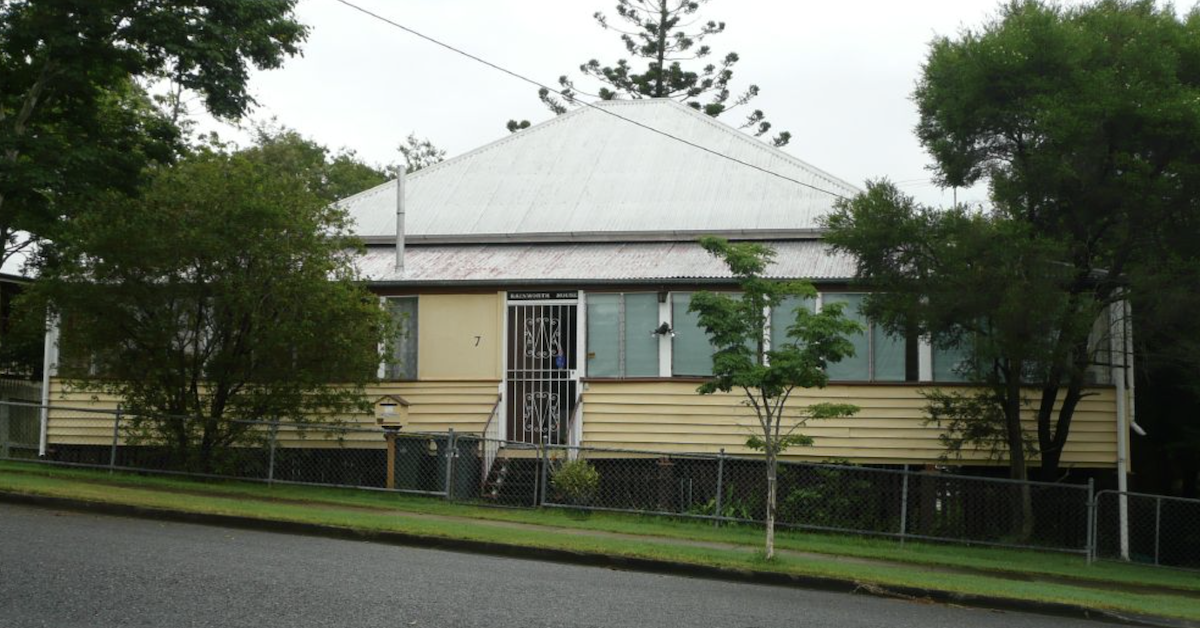
More than 160 years after it was built, Rainworth House remains one of Bardon’s most remarkable survivors.
Constructed in 1862 by explorer and Surveyor-General of Queensland Sir Augustus Charles Gregory, the heritage-listed timber home has witnessed Brisbane’s transformation from a colonial settlement to a modern metropolis. What was once a solitary farmhouse surrounded by open countryside is now nestled within one of Brisbane’s most sought-after inner-west suburbs.

Today, Rainworth House stands as a rare reminder of the district’s rural beginnings and the man whose influence helped shape Queensland’s early history.
A House That Gave Rainworth Its Name
Many locals recognise the name Rainworth from nearby roads, schools and landmarks, but fewer realise the area’s name originated from this historic residence.


Gregory named the property Rainworth after a village in Nottinghamshire, England, near his birthplace of Farnsfield. Over time, the name became associated with the surrounding district and remains part of Bardon’s identity today.

Built as a farmhouse, Rainworth was reportedly constructed by Gregory himself and served as both his home and rural retreat. At the time, it was the only farmhouse in the immediate area, standing amid what was then largely undeveloped land on Brisbane’s western fringe.
The Home of a Queensland Pioneer
Sir Augustus Charles Gregory is remembered as one of Australia’s most accomplished explorers. He served as Queensland’s Surveyor-General from 1859 to 1879 and played a significant role in mapping and developing the young colony.

Beyond his surveying work, Gregory was an influential figure in public life. He served on the Legislative Council, was active in local government, contributed to scientific pursuits and became a prominent figure in Queensland society.



Despite his public standing, Gregory chose to live in the relatively modest surroundings of Rainworth House. The property provided a place where he could think, write and pursue his many interests away from the demands of public life.
He remained at Rainworth until his death in 1905.
A Rare Piece of Colonial Brisbane
Rainworth House is significant not only because of its association with Gregory but also because of its architecture.
The residence is considered a rare surviving example of an 1860s timber dwelling featuring a steeply pitched short-ridge roof design. While many early timber homes were lost to redevelopment, fire or demolition during Brisbane’s growth, Rainworth endured.
Apart from the enclosure of its front verandah, much of the home’s original character has been retained. The interior still features rough-cut timber walls and wide-planked ceilings that reflect its colonial origins.
As Brisbane expanded during the twentieth century, the property became an increasingly uncommon link to the city’s early settlement period.
From Country Estate to Suburban Bardon
Following Gregory’s death, ownership of Rainworth passed to merchant and politician Robert Philp before being rented by subsequent owners.
As the original estate was progressively subdivided, the house was relocated to its present position on Barton Street. The move ensured the survival of the historic dwelling as the surrounding area evolved from rural land into suburban neighbourhoods.
In 1949, Frederick and Mildred Howell rented the property before later purchasing it. According to heritage records, descendants of the Howell family have continued to occupy the residence, making it not only a heritage landmark but also a long-standing family home.

More Than 160 Years Later
The contrast between Rainworth House’s origins and its present-day surroundings highlights the dramatic changes that have occurred across Brisbane since the nineteenth century.
When Gregory built the home in 1862, the area consisted largely of farmland and bushland. Today, Bardon is one of Brisbane’s most established and desirable residential suburbs.
Property records show the house sold for $862,000 in 2011. Current property estimates place its value at more than $2 million, reflecting both the growth of Brisbane’s property market and the desirability of the suburb that developed around it.
Yet Rainworth’s significance extends beyond real estate values. Its enduring importance lies in its ability to connect present-day residents with a period when Bardon was little more than a rural outpost on the edge of a growing colony.
A Living Link to the Past
Rainworth House was entered on the Queensland Heritage Register on 21 October 1992 in recognition of its historical and cultural significance.
More than three decades after receiving heritage protection — and 164 years after its construction — the home remains one of Bardon’s most important landmarks.
While Brisbane continues to change around it, Rainworth House stands as a tangible reminder of the people, places and stories that shaped the city’s early years.
Published 24-June-2026