




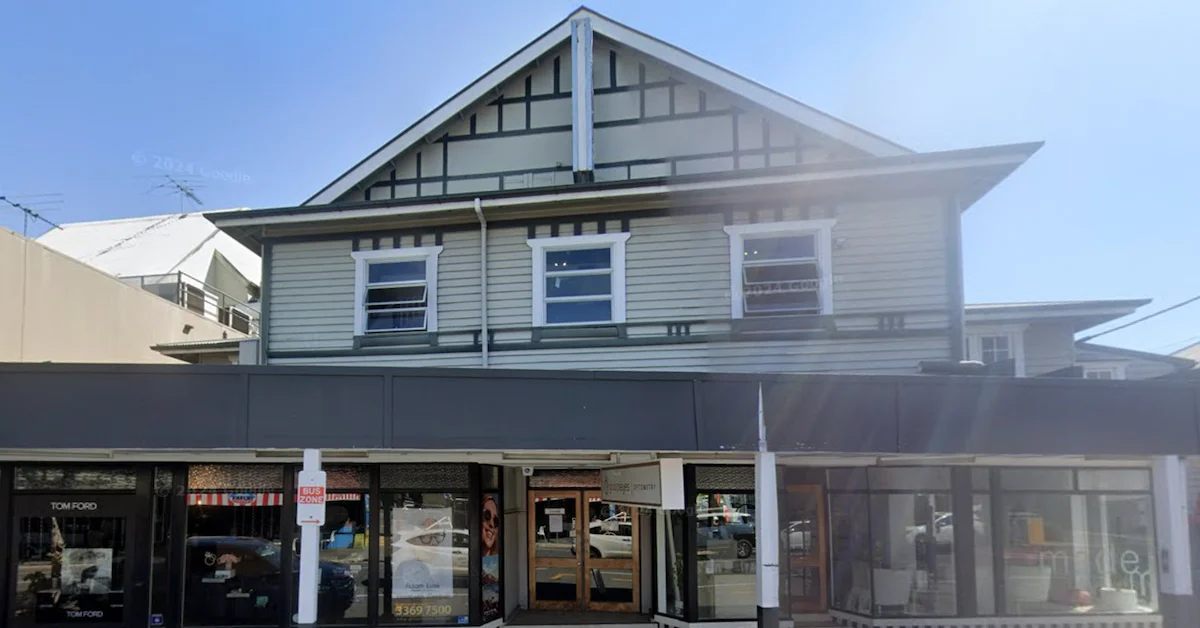
In Rosalie, a modest timber hall on Nash Street has always been more than it appears: built as a place to gather and remember, it was designed with shops tucked beneath the main hall, quietly funding community life while generations met, mourned, danced, learned and watched movies upstairs — a layered landmark that mirrors Rosalie’s own hustle and heart.
A hall designed to pay its own way
Walk past the former RSL Hall at the corner of Nash and Elizabeth streets, and it’s easy to miss the ingenuity built into its structure. The main hall sits above street level, while two shopfronts below — numbers 16 and 18 Nash Street — were deliberately included to generate income.

Rent from these businesses helped service the mortgage and keep the building operating, a practical solution by residents determined to sustain their own cultural hub.
This blending of idealism and realism was typical of Queensland’s Schools of Arts, which emerged across the state as towns and suburbs matured. According to the heritage overview, these institutions were often the first centres for adult education, debate and performance, at a time when books were costly and public libraries rare.


Why Rosalie — and why this site
The hall’s location was not accidental. A parkland site near Milton State School was initially offered, but the committee opted for the Nash Street corner block instead. An 1895 map labelled the park area “Red Jacket Swamp”, making higher ground more appealing for a permanent civic building.

Although the hall’s street address now places it in Paddington, Rosalie has long been recognised as a locality within the suburb, identified by residents well before modern council and postal boundaries were formalised. Historic maps and local records show Rosalie as a distinct pocket, with its own village centre clustered around Nash Street, Gregory Park and nearby schools.
Rosalie itself was developing rapidly by the early twentieth century. Nestled within Paddington, the locality grew alongside Brisbane’s tram network and expanding suburbs, evolving from semi-rural fringes into a close-knit residential pocket. Local history records note that Rosalie’s name likely derives from a Darling Downs grazing station owned by John F. McDougall, an early landholder in the area
The Rosalie School of Arts Commemoration Hall was named for the community it served, not a postcode. While later administrative changes absorbed Rosalie into Paddington for official purposes, the name has endured in local use — a reminder that neighbourhood identity often outlasts lines drawn on maps.


Education, remembrance and community life
When the hall opened in 1928 as the Rosalie School of Arts Commemoration Hall, it carried a dual purpose. It was both a centre for learning and social life, and a war memorial — reflecting the profound impact of World War One on Australian communities.
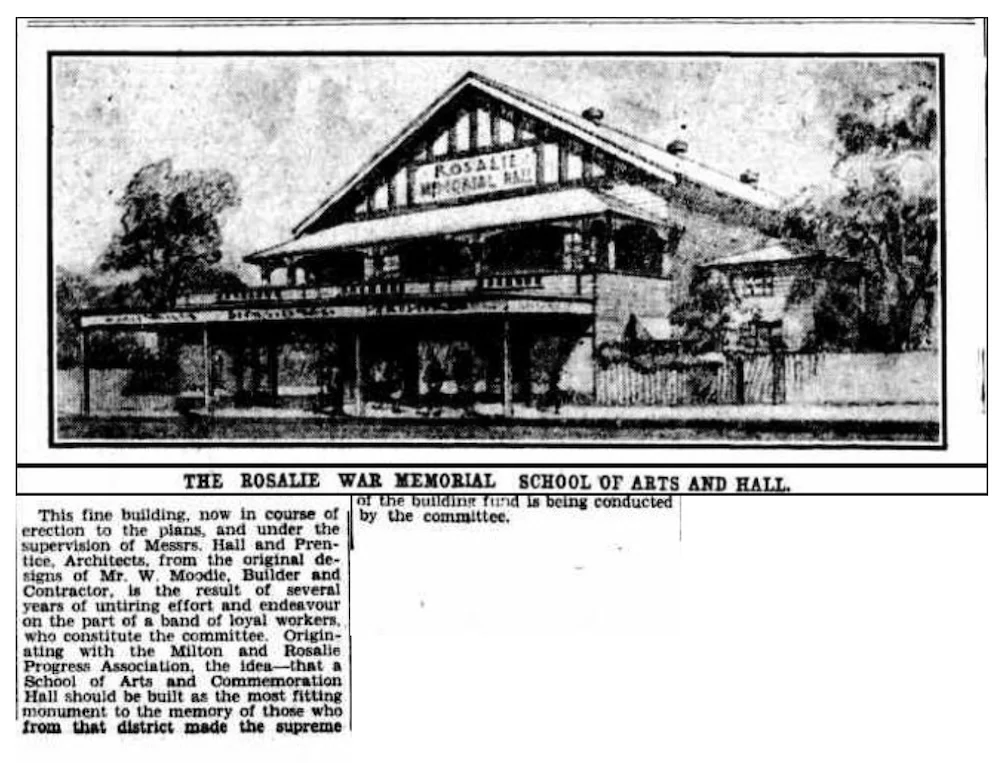
Across the country, thousands of memorials were built as families mourned servicepeople buried overseas. In Rosalie, remembrance was woven into daily life: lectures, concerts, meetings and library visits took place under a roof dedicated to those who had served.
The hall quickly became a hive of activity. A kindergarten operated there in the late 1920s and early 1930s, public meetings filled the calendar, and the space hosted dances, exhibitions and celebrations that helped define Rosalie’s social rhythm.
From memorial hall to veterans’ home
By 1934, the building had become the birthplace of the local Returned Sailors’, Soldiers’ and Airmen’s Imperial League of Australia sub-branch, later known as the Returned & Services League (RSL). The organisation would go on to shape the building’s future, reflecting Rosalie’s strong ties to returned servicepeople.
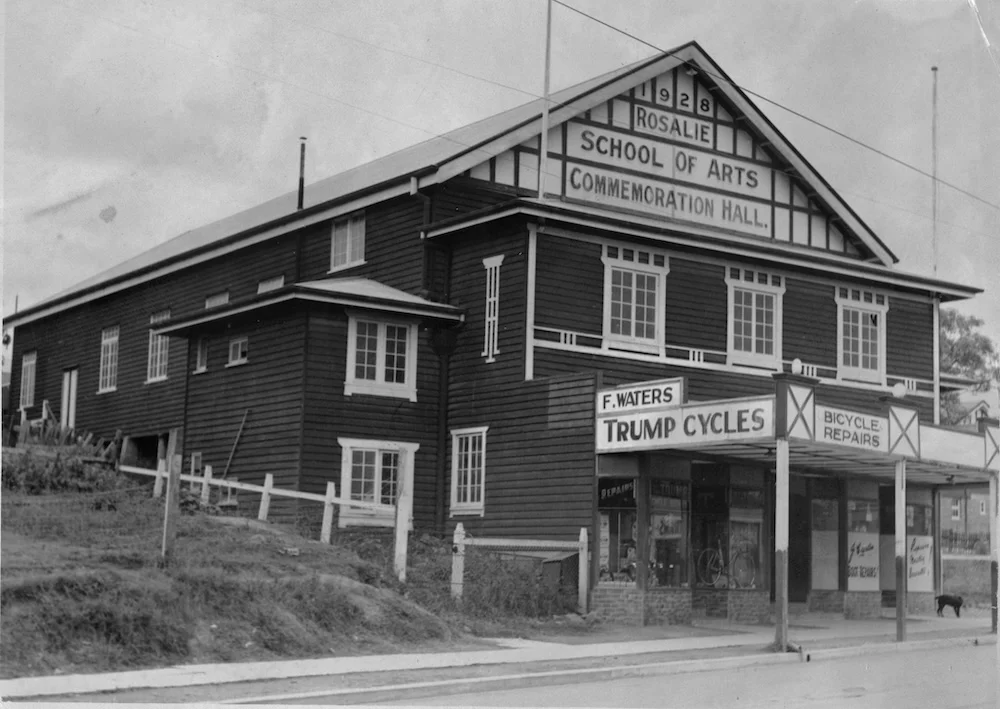
In 1946, ownership of the hall was formally transferred to the RSL under state legislation. The library collection moved to council facilities, and the building’s role shifted more squarely toward veterans’ affairs, while still remaining open to broader community use.
Lights, camera, Rosalie
One of the hall’s most unexpected chapters came during and after World War II, when it transformed into the 300-seat Beverley Theatre. On multiple nights each week, locals gathered to watch films without travelling into the city.
The Beverley Theatre joined a now-lost network of suburban cinemas that once animated Paddington and surrounding areas, turning community halls into shared entertainment spaces and reinforcing their role as social anchors.
While movies played and meetings unfolded upstairs, the shops beneath the hall continued their steady service. Over the decades, they housed a dressmaker, bootmaker, bicycle shop and a maternal and child welfare clinic — providing everyday services while financially underpinning the building itself.
Today, those commercial spaces remain active, just as the hall above continues to evolve.

Still adapting, still gathering
Alterations over time — new windows, changed awnings, enclosed stairways — reflect the hall’s ongoing adaptation. The interior has been renovated, and the main hall now operates as a fitness centre, while the RSL continues to lease it for meetings and commemorative events.
As Brisbane grapples with questions of density, development and heritage, Rosalie’s hall stands as a reminder that community buildings endure not because they stay the same, but because they adapt. Built on practical foundations and collective effort, it remains a living part of Rosalie’s story — layered, resilient and still in use.
Published 29-Jan-2026





.jpg)